

Most basketball players hit a wall not because of skill—but because of what’s happening between their ears. Joey Hewitt knows this firsthand—and it’s why he built his sports coaching business around mental performance training. As a Division III player who went from riding the bench freshman year to losing just five games over his next three seasons, Joey’s transformation came through mental performance coaching.
Now working with players at all levels through his FindJoeFlow brand in the Bay Area, Joey helps athletes unlock performance by training the mental side of the game alongside skill development—an approach that’s reshaping how sports coaching businesses differentiate themselves in competitive markets. In this episode of the CoachIQ Podcast, Joey breaks down the mental skills that separate good players from great ones—and why most sports coaching businesses are missing this crucial competitive advantage.
In this episode:
- Why being present is the #1 mental skill for peak performance
- The “fire and flow” framework for managing competitive emotions
- How to stop focusing on results and start playing freely
- The next play mentality that eliminates mistakes from your mind
- Why Division III athletes develop unmatched work ethic
- How to integrate mental training into your coaching programs


How the mental game shaped Joey’s sports coaching business
Joey wasn’t a natural. Growing up, he was always the shortest player, a late bloomer who struggled with confidence. “I was never really that good at basketball or any sports in general. I was pretty mid as the kids say these days,” Joey explains.
That insecurity followed him to Whitman College, where he expected to play right away at the Division III level. Instead, he sat. “I’m not playing and that really shattered my worldview. It shattered any semblance of confidence I had left.”
The turning point came when Joey did something most athletes—especially male athletes—struggle with: he asked for help. “The moment I opened myself up to be vulnerable was the moment that changed my career.”
Working with a mental performance coach, Joey learned breathing techniques, self-talk strategies, and visualization. Everything clicked. Over his final three years, his teams lost just five games total.
That transformation is why Joey now dedicates his sports coaching business to mental performance training. “The mental game started off as the thing that held me back, and it turned into something that really springboarded me to a new level.”

Being present beats thinking every time
Ask any coach what athletes need to perform their best, and they’ll tell you: be present. But what does that actually mean?
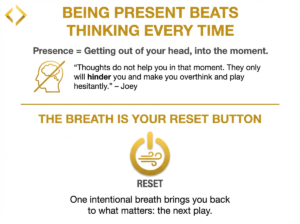
For Joey, presence means getting out of your head and into the moment. “In a game, the more you think, especially in basketball when you’re attacking the basket or playing defense, thoughts do not help you in that moment. They only will hinder you and make you overthink and play hesitantly.”
Think about the last time you played in the zone—where everything felt effortless, automatic, instinctual. You weren’t thinking about your shot mechanics or whether you’d score. You were fully immersed in what was happening right now.
For sports coaching businesses, teaching presence becomes a retention tool—parents see their kids not just improving skills, but developing mental toughness that translates beyond the court.
The breath is your reset button
Joey’s go-to tool for returning to the present? A simple breath.
“I would use a breath as a reset. Focus doesn’t have to be something necessarily philosophical or through language. Focus can be through feeling as well.”
When you catch yourself dwelling on a missed shot or worrying about the score, one intentional breath brings you back to what matters: the next play.
This is where automated session reminders help coaches reinforce mental skills training—you can send pre-practice prompts reminding players to use their breathing techniques before stepping on the court.
Results are the enemy of performance
Here’s the paradox: the more you focus on scoring, winning, or stats, the worse you’ll perform.
“Everything about your upbringing tells you to focus on results within sports,” Joey says. “It’s how you get minutes, it’s how you play, it’s how you get recognized, but it’s so ironic because that doesn’t mean you should focus on it.”
Joey experienced this himself even after learning mental performance principles. “I was like, yeah, I shouldn’t focus on scoring, but I still did it. I would know how many points I had. I’d constantly remind myself, I just need 10, I just need 10, let me get to 10.”
It wasn’t until years after college that he finally detached from results completely—and his performance reached another level.
For coaches building systems to track client development, this means using client management tools that emphasize process metrics—effort scores, attendance consistency, skill progression—rather than just outcome statistics.
This process-focused approach also applies to how you get paid. When you implement automated payment processing, you eliminate the mental overhead of tracking who paid and who owes—freeing your mind to stay present with coaching, not billing.
The next play mentality
So if you shouldn’t focus on results, what should you focus on?
Next play.
“Results are damn near always in the future or the past,” Joey explains. “You’re thinking about the points you want to score or the shot you just missed. You’re thinking about how you want to win the game or how you’ve lost to this team before.”
The next play mentality keeps you anchored in the present. Miss a shot? Next play. Turn it over? Next play. Get scored on? Next play.
This principle connects directly to skill development too. In training, focusing on the process—proper footwork, reading the defender, making the right pass—produces better results than obsessing over makes and misses.
Fire and flow: balancing competitive intensity
One question Joey gets from high-level athletes: “Can you be too present? Sometimes I feel so present that I lose my competitive fire.”
This led Joey to his “fire and flow” framework.
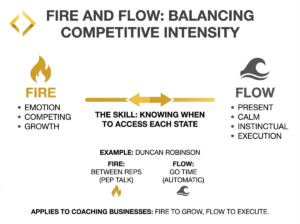
“My flow is being present, calm, instinctual. My fire is letting that emotion out and really competing. But if you do that the whole time, you’re going to burn out.”
The skill is knowing when to access each state—and this is something athletes can train.
Think about Duncan Robinson, one of the greatest shooters in basketball. He’s mastered this balance. “He has the emotional flexibility to self-regulate, to put himself in the optimal zone of performance,” Joey observes.
Between reps or games, Duncan might fire himself up with a pep talk (or some choice words). But once it’s go time, he shifts back to flow—calm, present, automatic.
This balance mirrors what successful coaches experience when scaling from solo training to managing multiple facilities. You need fire to compete and grow your business, but flow to execute systems efficiently without burning out.
Joy isn’t soft—it’s strategic
Playing with joy isn’t just about having fun. It’s a performance enhancer.
“Having fun is a great way to loosen yourself up and remove some tension,” Joey explains. “A lot of times athletes get tense in their muscles when they play sports. Having fun is the counter to that.”
Joey’s Whitman College teams embodied this. Before that second-round NCAA tournament game, the team was dancing in a room, loose and connected. “We were so confident that we were gonna win, we didn’t even have to focus on winning or losing, which freed our mind up to focus on playing with joy.”
Their coach, Eric Bridgland, constantly emphasized celebrating each other and playing with joy. The result? Barely any losses during Joey’s final three years.
This connects to skill acquisition science too. When players are relaxed and enjoying themselves, they move more fluidly, process information better, and learn faster. Tension restricts movement and narrows focus.
For coaches, creating this environment means reducing unnecessary pressure in training while maintaining high standards—a balance that becomes easier when automated scheduling and session reminder systems eliminate the administrative stress and last-minute no-shows that often make coaches rushed and tense.
The Division III work ethic that builds successful sports coaching businesses
There’s something special about Division III athletes who make something of their careers.
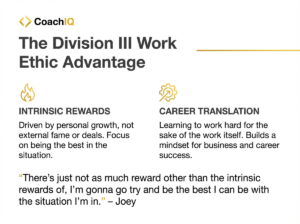
“There’s just not as much reward other than the intrinsic rewards of, I’m gonna go try and be the best I can be with the situation I’m in,” Joey notes.
These athletes aren’t chasing NBA dreams or NIL deals. They’re learning to work hard for the sake of the work itself—a mindset that translates directly to building successful businesses and careers after basketball.
Joey’s own path proves this. From struggling freshman to successful mental performance coach and trainer, the work ethic developed at the D3 level carried him through every challenge—including building a sports coaching business from the ground up.
Why sports coaching businesses need mental performance training
Here’s what most coaches miss: mental skills aren’t just for elite athletes. They’re a competitive differentiator for your entire sports coaching business. While most training businesses compete on price and convenience, integrating mental performance lets you position your sports coaching business at the premium end of the market.
When two trainers offer similar technical instruction, the one who also develops mental toughness, emotional regulation, and presence wins the client retention battle. Parents see their kids not just improving skills, but becoming more confident, resilient athletes.
Joey’s approach is unique: he blends mental training directly into basketball workouts rather than treating it as separate.
“I really believe in the idea that you can train the mind while training your basketball skills. It’s actually a little bit better to train your mind while you’re training your basketball skills because you’re gonna need to use those mental skills in the heat of the moment.”
This means:
- Taking a breath before each rep to reset and get present
- Practicing next play mentality during drills (miss a shot, immediately move to the next rep without dwelling)
- Putting pressure on yourself in training (make 5 out of 8 rather than just shooting)
- Incorporating game-like scenarios that require managing emotions
For coaches building comprehensive training programs, this is where program management tools become valuable—you can design sessions that intentionally incorporate mental skills checkpoints throughout the workout, tracking both physical and mental development over time.
How most training misses the mental component
Walk into most basketball training sessions and you’ll see stationary ball handling and shooting reps. What you won’t see is intentional mental skills work.
“Can we evolve the training field? Can we evolve player development?” Joey asks. “It doesn’t have to just be stationary ball handling and getting shots up. You can do ball handling with a tennis ball and you can do shots with pressure.”
The coaches who integrate mental performance training with skill development give their players a massive competitive advantage—and give their sports coaching business a clear differentiator in crowded markets.
Just as group training requires different systems and pricing strategies than individual sessions, integrating mental training requires intentional program design. It’s not an add-on—it’s woven into every drill, every rep, every coaching cue.
For coaches managing multiple athletes across different programs and mental readiness levels, having centralized client tracking lets you note which players need help with competitive intensity versus those who need to learn to calm down—creating truly individualized development plans.
Adding mental performance training to your sports coaching business
You don’t need to become a certified sports psychologist to incorporate these principles. Here’s how to start:
Start with breathing. Before every drill or rep, have athletes take one intentional breath. This trains presence and creates a reset ritual they can use in games.
Build next play language. When a player misses or makes a mistake, your first words should be “next play.” Make it automatic. This trains athletes to stay in the moment rather than dwelling on the past.
Create pressure in practice. Design drills with consequences—make 7 out of 10, three-minute time limits, winners and losers. This trains emotional management in a controlled environment where failure is safe.
Track mental metrics alongside physical stats. Note which players respond well under pressure, who dwells on mistakes, who competes with joy. These observations inform how you coach each athlete.
When you’re tracking both mental and physical development across dozens of athletes, coaching analytics and reporting tools help you identify patterns—like which training environments produce the most confident players, or which athletes need more competitive pressure versus more flow-focused sessions.
Educate parents on the mental game. Help them understand that confidence, resilience, and presence are skills their kids are developing—not just basketball fundamentals. This justifies premium pricing and improves retention.
For sports coaching businesses managing this level of detail across 30+ athletes, comprehensive client management systems let you track mental development notes alongside physical progress—creating the individualized approach that retains clients long-term.
Working with Joey: mental training and skill development
Joey offers both in-person and remote mental performance coaching:
In-person (Bay Area, California): A blend of mental training and basketball skill work, integrating mental skills directly into on-court sessions.
Online: Regular Zoom sessions throughout a season where athletes learn mental skills (breathing exercises, visualization techniques, journaling), discuss challenges, and have a third-party sounding board. This model demonstrates how virtual coaching platforms let trainers expand beyond their local market while maintaining quality relationships with athletes.
For coaches ready to create a premium brand experience, a custom branded mobile app becomes the hub where clients access training content, book sessions, and stay connected—positioning your sports coaching business as more professional than competitors relying on text threads and Instagram DMs.
“My Instagram, just going to my Instagram and going through the feed will help you kind of open your mind to the mental game,” Joey says. “I just post a bunch of pro athletes talking about the mental game or exuding the mental game through their actions.”
Follow Joey at @FindJoeFlow on Instagram or visit JoeFHewitt.com to learn more about mental performance training.
Ready to spend more time coaching and less time managing logistics? CoachIQ’s all-in-one coaching platform handles scheduling, payments, and client communication automatically—giving you more time to focus on developing complete players, mentally and physically.
Full Episode Transcript
The following is a lightly edited transcript of the episode above.
▶ Click to expand full transcript
Russell: Perfect. We are here with Joey Hwitt aka find Joe Flow on Instagram. And the backstory here is an interesting one. Joey knocked me out of the NCA tournament in a very controversial ending. We were just reminiscing on that. But I needed to address that at the start of the podcast so we don’t need to go back to it. Joey is doing an amazing job online talking about the mental side of the game and works with a lot of players from all levels on the mental side and on the skill side. So Joey, incredibly excited to talk to you and hopefully forge a new memory with our relationship going forward.
Guest: Thanks for having me, Mitchell. It’s a pleasure as always. Love talking about hoops, the mental game. Yeah, excited for it, man. I love it. And I know I can say as a player, you were a hooper and I’m sure you’re still hooping and if any player were to challenge you, you give them some buckets, but I’m sure there were some challenges along the way. I would love to go into your playing career and the mental challenges you faced and how did that shape what you do today.
Russell: Yeah, absolutely. I’m a mental performance coach for a reason. It’s because I struggled with the mental game growing up. And when I was growing up as a kid, I was never really that good at basketball or any sports in general. I was pretty mid, as the kids say these days. And that created a lot of mental issues. the the biggest one I would say for me was I was always very short and I was a late bloomer. So to any kids or athletes out there who feel like they’re a late bloomer or short or small, I just want to remind you that I struggled with those exact same things and they really affected my confidence. But they don’t have to define you. and that’s something that really I had to to come to terms with. when I was in high school, I was a freshman on freshman. I was a sophomore on JV and junior year I finally made varsity. I wasn’t anything special growing up. And it wasn’t really until after my junior year in high school when I started to really just connect with my love for the game and really started to grind and work hard at it and I started to learn the value of hard work. And, I was lucky enough to go play at Whitman College. I had a great career there. It’s a division three school up in Washington State. And it’s funny because, I had a great career there, but the start of it was rock bottom for me. When I got to Whitman as a freshman, I was assuming I played D3. I’m going to play right away. that’s what my coach promised me. I didn’t really have a lot of looks coming out of college or coming out of high school. I was either going to walk on at a D1 or go play right away at a D3. I was like, “Okay, I’ll go play right away at a D3.” And then I get there and I’m not playing. And that really, really shattered my world view. It shattered any semblance of confidence I had left. And what happened there is I asked for help, which was one of the hardest things I’ve ever had to do. A lot of athletes, especially male athletes, struggle with that, just being vulnerable. But the moment I opened myself up to be vulnerable was the moment that changed my career. I got in touch with a mental coach who ended up becoming my mentor and helped me get into the field. and he just really, emphasized the the the mental skills such as breathing technique, such as self-t talk, such as visualizing myself. And I started to really just commit to that part of the game and everything took off. Everything clicked for me. my first year in college was rough. It was a it was a grind and I wasn’t seeing results and I wasn’t very confident. But once I started to really connect with the mental game, my sophomore, junior, and senior year went amazingly. I lost five games in three years in those three years and it was just really really a great experience for me. So for me the mental game has been a roller coaster. It started off as the thing that held me back and it turned into something that really springboarded me to a new level and that’s really why I fell in love with it and I was lucky enough to continue playing overseas after that. I got my masters in sports psychology over in England when I was playing and yeah at this point now I’m done playing. can still give anyone a bucket if they’d but I’m more focused on training, doing mental performance coaching and basketball training up here in the in the Bay Area in California.
Guest: Yeah, I really like that story because I think at the division three level, that is the the idea that a lot of people have going into it, you know? All right, if I’m if I’m not going D1, I’m going to go D3 and just kill it. And then you go there and you realize that everyone there was a bucket in high school, probably the best player on their team still, and the level is really really high. And there are a lot of downs there, except the reward of playing isn’t as sweet as it is at many of these other places. we were talking a little bit beforehand about division 3 basketball players, especially those that work and grind and make something of your career at a division 3 school. I feel like they have learned a work ethic that’s very different from anyone else because there’s just not as much reward other than the intrinsic rewards of I’m going to go try and be the best I can be with the situation I’m in. And I think there’s there’s a beautiful story with that and I think it translates afterwards with what you’re doing right now and and the business that you’ve built and how many kids you’re helping. I would love to quickly go back and tell a story. I don’t know if you remember this, but I have a very clear memory before that second round game up at Whitman where I think I went down the wrong hallway and your whole team was in like a dance room and there was music going and you guys were in sync and at that point I was damn, these dudes are connected. I don’t know if the program had a an emphasis on the mental side of things, if that came from you, but for sure the feeling in that in that room with that you guys created before the game was just this feeling of confidence. You knew what you were about to do and you were going to go do it. Can you talk about that? Was that a pregame ritual? What was that dance room thing?
Russell: Yeah, it’s funny you say it was a dance room. It was a dance room and there was a lot of dancing in that room. I think that was just a testament of how we were, we were so I wouldn’t say loose. we were loose in the sense of we didn’t really focus much on the result because I think we had built so much confidence that we were going to win. we were so good and we barely lost in my time there that we didn’t even have to focus on winning or losing which freed our mind up to focus on what our coach Eric Brrisand was so good at instilling in us was just playing with joy. we would visualize before every game and we’d talk about playing with joy all the time, having fun when you’re out there. And as I was starting to learn about the mental side of of sports, I started to really dive into the research on having fun and just playing with joy. And it’s so connected to my experience at Whitman because I was having a lot of fun. We were celebrating each other a lot. Like that was a big staple of our program. And it allowed us to one quiet our minds and two have a little more looseness within just like the idea of a lot of times athletes get tense in their muscles when they play sports or just their body in general. Having fun is the counter to that. Having fun is a great way to loosen yourself up and remove some of that tension. So I really believe, it’s backed by research and it also is just from my experience. That was a huge proponent of our team was just having fun, celebrating everyone and not really caring about the result. It helped a lot.
Guest: Absolutely. Joy is a term that I have used a lot this past year. We made it one of our pillars at Elevate Basketball, which is where I run everything in the summer because like you said, I think it is incredibly important from a performance standpoint, but also from a a skill standpoint and how you can get better faster. And that’s I think one of the shifts that a lot of our players have made that’s been probably the most important in their careers so far. Have you seen any other shifts like that? maybe the focus on joy or any mental shifts that you feel like players need to make if they want to have success at higher levels.
Russell: Yeah, I’ll go back to the other piece of that is not really focusing too much on results or what’s at stake. that’s probably the thing I hammer home most to athletes that I work with, especially younger athletes, because it is something that is ingrained in sports. we are trained to focus on results. When we grow up, all we see is results. If you watch Sports Center, all you’re going to see is the stats, the numbers, the wins, the losses, the highlights of the good plays, the makes. You’re not going to see really the process it takes to get there. I think that is probably the biggest thing within sports that is the hardest to do because everything about your upbringing tells you to focus on results within sports. it’s just like it’s it’s how you get minutes, it’s how you play, it’s how you get recognized, but it’s so ironic because that doesn’t mean you should focus on it. And I think it took me a long time to get there. It took me beyond college to get there. When I first started learning about the mental game, that was the thing I was really really struggling with. Even though I was aware of all of the ideas, and I agreed with it. I was like, “Yeah, I shouldn’t focus on scoring, which was the result for me, the specific one I attached to a lot.” But I still did it. I would know how many points I had. I’d constantly remind myself like, “I just need 10 more. I just need 10. I just need 10. Let me get to 10.” and it really did hinder me more than I realized. I didn’t know until I was 24, 25 years old, though once I really started to detach from all of that stuff. I’d say that’s probably the biggest one that athletes everywhere at all levels struggle with. We focus too much on results. It doesn’t mean you shouldn’t care about results, but in the heat of the competition, when your shoes are laced up and you got your jersey on and the tip off has happened, results serve you no good at that point. I think it’s a really important detail to understand is like you can focus on results, you can like them, but the more you get attached to them, the more you’re going to think about them in the midst of competition. And the more you think in the midst of competition, the worse you’re going to play.
Guest: What would be some practical ways to make that switch? Like I’ve heard the example of the pink elephant, When someone says, “Don’t think of a pink elephant,” everyone automatically thinks of it. So then the question is, if you don’t want to focus on the results, where can you put your focus so that you’re not thinking about the results? Because it’s it’s hard to just not think of something, but like where where do you encourage players to put their focus?
Russell: Hey, I just want to take a quick break. My name’s Russell. I’m one of the founders of Coach IQ. We put on this podcast here. Our goal is to interview top coaches and business owners in the youth sports space across the United States and give you guys insight on the ground floor. How are they running their business? what do they think about the current ecosystem and what are their thoughts on where things are going? we’re super excited to bring this to you guys. If you don’t know about us, we are an all-in-one sports management platform. We run a lot of the businesses that we have on the podcast and we’re fortunate enough now to work with about a thousand sports coaches across the United States and it’s our goal to make your life as easy as possible in running the business itself. Website, scheduling, payment management, everything handled seamlessly on our platform. And really what separates us is we are built specifically for sports. We’re not powering nail salons. We’re not powering Pilates studios. Every second of the day we focus on you. So if that’s something you need where you’re looking to get your time back or you’re looking to grow your business, Coach IQ is really the only platform thinking about you every single day interviewing and working with the top coaches in the industry specific to sports. if that’s something we can help you with, we would love to connect with you. You can visit our website, coachiq.com, schedule a free demo there. The demos are awesome. It’s really less about selling and much more about just walking through what we’ve learned and providing value on what other coaches are doing. And if it’s a match, it’s a match. absolute no-brainer. Go schedule a demo. worth the time. And thank you guys for tuning in. Thank you guys for watching. Thank you for customers who are working with us. It allows us to do all this make better product and the main goal help athletes all across the United States and the world get a phenomenal experience from you guys the coaches.
Guest: Yeah. it’s a great question. I think a lot of people do that. I I one of my big principles within my work with athletes is I don’t like the word don’t. I don’t like anything that anything that they write down if it starts with don’t like don’t make a mistake, don’t mess up, your brain’s going to think about the other side of it just naturally. I would say the two things the two things that I would answer to that are connected to the same principle, which is really just a common phrase that you’ve heard from every coach in America or England. Next play. Next play mentality to me is the number one counter to that because think about results and where they bring you. A lot of the time when you miss a shot, you’re living in the past. You’re thinking about that result that just happened instead of focusing and putting all of your energy onto what you’re going to do next. The other thing I think that really helps me, especially, when I was focused on scoring a lot was a simple breath. When you think about focus, it doesn’t have to be something necessarily philosophical or through language. focus can be through feeling as well. And I think I found a lot of benefit through I would be focusing on scoring. I would use a breath as a reset. So really what I’m saying through both of those things, I’m going to focus on being present. I’m going to focus on the moment in front of me because results are damn near always in the future or the past. You’re thinking about the the points you want to score or the shot you just missed. You’re thinking about how you want to win the game or how you’ve lost to this team before, so it’s going to be a tough game. we all live in fear in sports for the most part because we project the past into the future. We use the past and go to the future from that past experience. The problem there is you’re skipping the most important part of life. You’re never living in the present. So to me, if I think that is the number one thing is like how do you get rid of results? You got to be in the moment. And I think it connects as well to having fun and joy. when you are having fun and focused on supporting each other and just building up that that positive energy, results don’t really matter as much. I love how everything connects and it makes so much sense. I would love to dig into being present a bit more and I told you this before the podcast. I want to brainstorm a bit because I’ve heard being present probably from every single coach, every basketball coach, every strength coach, every psychologist I’ve talked to. There seems to be this universal opinion that being present is probably the most important thing for optimal performance. And when I look at this from a guy who comes from more of the skill side and skill acquisition science, my view is that skill is effective self-organization. So your body is taking in all this information from the environment. You have a general idea of what you’re trying to go accomplish. Put the basket put the ball in the basket. move your body in front to stay in front of your offensive player as a defender. We have the idea of what to do, but there’s an environment and there’s an individual and you’re needing to selforganize within that environment to execute this task. If you are present, I think that gives your body the best chance to move and execute those skills. not only is it the reason or or going to help you from a mental side, but I think physically you’re going to be doing things that are more productive towards the game. I would love if you could talk or critique that thought process or maybe brainstorm a bit on why is being present so universally agreed upon as a positive thing.
Russell: Yeah, I I think you hit the nail on the head, man. think about when you’re playing hesitantly or when you’re playing indecisively in sports. that’s a physical thing. Maybe you tense up. Maybe you feel like a little jittery. It’s a physical physiological response to being in the past or the future. And I know you’re in the past and the future because a lot of the time when we overthink or when we hesitate, we’re thinking like a lot of those times we are thinking about things. So when you have being present coupled with the idea of just instinctual movement, now you’re creating a lot of realistic things that are going to happen in a game. in a game, the more you think, especially in a in a standpoint of like basketball, if you’re attacking a basket or if you’re playing defense, thoughts do not help you in that moment. They don’t they only will hinder you and make you overthink and and play hesitantly like I mentioned. yeah, I think it’s like every athlete has talked about the zone, like they all know what that feels but I’m not sure how many athletes understand that really what that is is being fully immersed in the present moment. It truly is the greatest feeling in the world and it is something that I’m sure both of us have felt before and the reason why it is so great is because we’re not thinking. So if you can train that like with through basketball training the best way to train that is like the stuff you do. I think I I use a lot of your stuff with my work with athletes on the court as well. Like just being able to get them to play without thinking and the best way to do that is to be present. So even like taking a breath before you do a rep I think is a great way to just clear your mind and reset and now you’re connecting the mind and the body. The one critique I will mention or something that I’ve gotten a lot and I’ve felt this before as a player is there are times when people feel too present and they feel like being present makes them almost feel like zoned out where they’re just there. They’re not having any fire to their game. They’re just emotionless. And I’ve had a lot of players tell me, “I agree with being present, but sometimes I get too far into that.” And sometimes I feel like I’m just just there and I don’t have any agency and I’m not really thinking at all, which isn’t allowing me to get out of the situation I’m in. I’m curious to hear if you’ve heard that before and what your thoughts are on that because that’s something I’ve heard a lot from especially highle athletes. It’s funny you mentioned it because this summer was one time where that did come up and again it was with a high level athlete who he’d played high major multiple different schools think top of the top programs the blue bloods he had played there for many years on some final four teams and it almost was like he was just burnt out like whatever the hormones or the chemicals in your body are to compete that drive you to have motivation to strive for something were like they were depleted I don’t know necessarily what it was, but we took some time where we we took away a lot of the results. We took away all the metrics of success or failure for months and we just focused on joy and playing basketball for the reason he started to play as a young kid and fell in love with it. And I think that helped to reset a bit. But I do agree to that point. Like I think there is something to just the over competition where you play a high school season. You put all your emotion into that and you go straight into AAOU, you’re competing, you’re competing, you’re competing, and then you go fall and now they’re having fall AAOU. So you’re playing games, you’re playing games, you’re playing games. And I think what either happens is people get burnt out or the games that should matter don’t matter because you’ve just played so many. And I think maybe having times built into a year or having times built into workouts where hey this one we’re we’re not going to focus on competing there’s no winner there’s no loser as contrary it is to me to say that as someone who loves to compete but I think it is good to have those resets and it’s really important from the mental side too to understand all right this is now not time to be competing like we can compete for an hour but then the rest of the day like let’s shut it down so maybe turn off social media go for a walk in nature. Find ways that’s really low stimulus to just disconnect a bit so you can replenish those stores of motivation. That’s just a a a thought or a hypothesis, but it’s it’s a great point and something that I think is really important as we see young hoopers who are so stimulated every waking hour from their phone to playing to school to whatever else it is.
Guest: That’s why I think it’s really about balance. that’s such a big part of the mental game to me. It’s it’s about balance. It’s not black and white, and it’s you can be too far into into being present. You can be too far into like competing to the point where you burn out. That’s why, I like to use the the terms fire and flow. And that’s really where I’m trying to tap into every time I step onto the court. I’m just monitoring my fire and my flow. To me, my flow is my flow and my fire can both bring me to the present moment, but they do it in different ways. my fire is letting that emotion out and really competing, but if you do that the whole time, you’re going to burn out like you mentioned. I think having the balance is the key and that’s something that’s a skill. All athletes can learn how to do that. skills are so much they’re far beyond fundamentals of dribbling, shooting, and rebounding. The skills that are really important in basketball are skills that no one talk about. To me, it’s really like being present, responding from mistakes, being able to handle a situation no matter what you’re in. adapt adaptability. And I could go on and on, but like to me, those are the skills that require those are the skills that will put you in position to play a high level basketball. Absolutely.
Russell: More important when you get up to the higher level.
Guest: Absolutely. Because like we talked about, everybody’s good. Everybody’s good at the sport. what’s going to differentiate? And that that term fire and flow I connect with so much. I think Duncan Robinson is one of the greatest shooters ever because he has that ability. He has that skill to understand when he’s in flow and he can stay in it and when he’s not, he uses almost like a fire like he fires himself up to put him back to that flow state. And so it’s really interesting watching him in a workout to get himself going. He’ll take his time in between reps or in between games and like give himself a pep talk. Maybe he’ll say some things, say some explicits, and then as soon as it’s go time, he’s back to this peace and he’s back to that balance. And he has the emotional flexibility or whatever you want to call it to self-regulate to put him in the optimal zone of performance, which is I think incredibly important when you’re shooting especially because that requires some touch. It’s not just something where you can grind it out like maybe on defense where you could just fire yourself up and you’ll perform that at an adequate level. But man, love this conversation. Love the flow of it. I think we should absolutely run it back. I want to end with understanding what it’s like as a player to come to you and work with you. What does that entail assuming I’m in person? And then what does that entail assuming I’m far away from you and how would I still be able to work with you?
Russell: Yeah. based in the Bay Area, California. So in person, a lot of a blend of mental training and and basketball training. That’s something that I am really passionate about. It’s something that I don’t see a lot of trainers do. and it’s some it’s a great way for me to distinguish myself as just different. I I really really believe in the idea that you can train the mind while training your basketball skills. It’s a little bit better to train your mind while you’re training your basketball skills cuz you’re going to need to use that those mental skills in the heat of the moment. I have a website that’sindflow.com. I have an Instagram find Joeoflow. And online, a lot of what I do is the mental side. I meet with athletes on Zoom throughout the course of a season. we learn the mental skills, which is really how it is that that’s how it is structured. It’s mental skills training. but really it’s just a way for an athlete to air out their thoughts, to talk to me about the season, talk to a third party, an unbiased third party, and then learn some things that can help them on the court, whether it be journaling techniques, breathing exercises, learn how to effectively visualize. and then the goal is to just continue to train the mind in those sessions. in person, online, I think it’s all really just about spreading the awareness of the mental game. My Instagram, just going to my Instagram and going through the feed will help you open your mind to the mental game. I just post a bunch of pro athletes talking about the mental game or exuding the mental game through their actions. yeah, that’s that’s generally how I do it. But I I think the goal in general, and I love what you’re doing, too, is just to like can we evolve the training field? Can we evolve player development? It doesn’t have to just be stationary ball handling and getting shots up. you can do ball handling with a tennis ball and you can do shots with pressure. Make five out of eight. I think just do doing that type of stuff if you’re an athlete, putting more pressure on yourself in training is a great way to train the mind.
Guest: Yeah, I really appreciate how you’re pushing the envelope. And I want to second going to your Instagram is a great Instagram to be at. Whether you’re just looking for some motivation or you want to set up your algorithm to promote more positive things, I think following at Joe Find Joeoflow is is one of the best follows there is right now. really appreciate you coming on. We’ve plugged the Instagram a bit. We’ve plugged your website, but just for one final plug, give us where can people contact you?
Russell: Those two for sure. And I something that I think a lot of people do is, shoot me a DM on Instagram. I’m pretty good with my DMs. if you have any questions on the mental game, if you have any just like ideas or anything that you’re curious about, please feel free to reach out via Instagram. I think that, especially athletes and and parents of athletes, they they see a lot of stuff on Instagram now. like you said, being able to curate your feed or change the algorithm a bit. I promise you it’ll be positive stuff in your life.
Guest: All right, Joey, I appreciate you coming on and we’ll absolutely run it back one time soon.
Russell: Yes, sir. Appreciate you having me, man. Thank you.
