

Learning how to run a sports coaching business successfully comes down to three fundamentals: pricing strategy, systematic operations, and consistent client acquisition. Russell Reeder, founder of CoachIQ, has worked with over 5,000 trainers and currently powers about 1,000 coaching businesses—and he’s seen exactly what separates thriving six-figure operations from struggling side hustles.
The biggest issue holding coaches back? Most copy their pricing and offer structure from other trainers without thinking through what actually works for their business and their athletes. Fix that foundation, and everything else becomes possible.
In this episode, Russell breaks down:
- The #1 mistake that keeps trainers from running a profitable sports coaching business
- Why your pricing strategy matters more than your coaching skills for business growth
- The exact blueprint for getting from a few thousand per month to $10K+ in recurring revenue
- How to structure offers that scale while improving athlete results
- The referral systems that fuel sustainable growth

Where most trainers fail when running a sports coaching business
Russell’s worked with enough trainers to spot the pattern immediately. Coaches look at what everyone else is charging, assume one-on-one sessions should cost more because they take more time, and never question whether that model actually serves their business.
The problems compound fast. A complicated offer structure plus poor pricing multiplied by 100+ athletes creates chaos. You’re buried in admin work, your calendar is impossible to manage, and you have no idea when your next dollar is coming in.
The coaches who run successful sports coaching businesses start with streamlined offers and smart pricing—like Tyler Leclerc’s approach to building two profitable training facilities by focusing on systems from day one.
The foundation of a profitable sports coaching business
Before you focus on marketing or fancy equipment—get your pricing right.
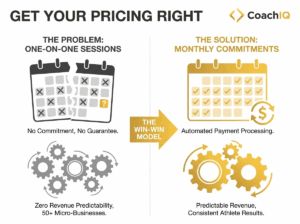
Most trainers Russell talks to offer one-on-one sessions with no commitment. Some have 50, 75, even 100 athletes, but they’re scheduling each session individually with no guarantee the athlete returns.
This model breaks for two reasons:
For your business: You have zero revenue predictability. You’re essentially running 50+ individual micro-businesses instead of one systematic operation.
For the athlete: They can’t get real results without consistency. One session here, another three weeks later doesn’t produce development.
The solution: monthly commitments with automated payment processing. Parents pay automatically, you get predictable revenue, and nobody’s chasing Venmo payments.
The $100K blueprint: Three foundations
Getting to six figures requires three elements working together.
1. Price for commitment, not convenience
Stop charging per session. Russell recommends monthly memberships as the baseline—athletes commit to training once per week for a minimum of one month.
The surprising part? Parents actually want longer commitments. Russell sees coaches successfully selling three-month and six-month packages. Any parent serious about their child’s development understands that real improvement takes time.
2. Have a consistent training location
You need a reliable place to train—whether that’s opening your own facility, a rented gym space, or a local park. It doesn’t have to be fancy, but it needs to be consistent.
3. Master your client acquisition channels
Russell identifies three primary channels:
Referrals (highest priority): By far the biggest growth source. If you’re a good coach and an athlete has a great experience, parents tell their friends. Your referral rate tells you everything about your coaching quality.
Local paid ads: Facebook ads targeting parents in your area work extremely well. Parents have massive pain points—they want quality coaching to guide their child through youth sports chaos.
Camps and clinics: Most coaches view camps as revenue events. The bigger opportunity is using them as client acquisition for your membership business. Scheduling automation for multi-day events removes the administrative headache so you can focus on delivering an exceptional experience.
Russell emphasizes that group training economics justify higher revenue per hour than individual sessions while developing better players through competition.
Scaling from $3K to $10K per month
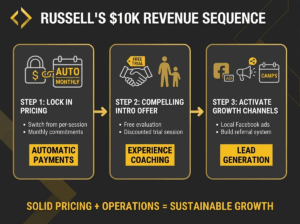
You’re making $2,000-$3,000 monthly and want to hit $10K in recurring revenue. Here’s Russell’s sequence:
Step 1: Lock in your pricing model. Switch from per-session to monthly commitments with automatic payments.
Step 2: Create a compelling intro offer. A free evaluation or discounted trial session lets parents experience your coaching. If you’re great, your conversion rate should be extremely high. Keep it simple—every athlete goes through the same process.
Step 3: Activate your growth channels. Set up local Facebook ads, build a referral system by actively asking current clients, and schedule regular camps as lead generation opportunities.
This combination—built on solid pricing and operations—is exactly how to run a sports coaching business that grows sustainably.
Why systems matter more than skills
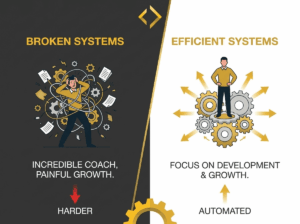
Here’s what most coaches miss: You can be an incredible coach, but if your systems are broken, growth becomes painful.
Russell talks to coaches with 50 athletes and poor systems where every new client makes their life harder. That’s backwards.
When your client management system keeps athlete information organized, your communication happens through automated reminders, and clients access everything through a branded mobile app, you have time to focus on athlete development and business growth.
The coaches crushing it on Russell’s platform share common traits: clean simple offers, pricing for value instead of time, automated systems, referral-driven growth, and long-term thinking. One coach started with a single gym and has since grown to five locations doing over $3 million annually—without expanding to a different state.
That’s possible because they got the foundation right.
Getting started
Whether you’re making $2K or $20K per month, Russell’s team will review your business for free. They’ll examine your pricing structure, identify improvements, and share what they’ve learned from powering 1,000+ coaching businesses. You don’t have to use CoachIQ—they’ll provide value regardless.
Book a free demo to get your business reviewed by people who’ve seen what works across thousands of training businesses.
Full Episode Transcript
The following is a lightly edited transcript of the episode above.
▶ Click to expand full transcript
Host: Welcome to the podcast, Russell Reer, co-founder of Coach IQ. Russell, thanks for being here.
Russell: Yeah, thanks for having me.
Host: I’m excited to jump in and get everybody on board with what Coach IQ is up to. It’s been something since I implemented it into my business has probably been the the biggest help in scaling my business because a lot of trainers try and do it all on their own and all with their phone and it gets to be a little crazy. So would love for you to talk a bit about Coach IQ. What is it? Who do you guys serve? And what value do you bring to them?
Russell: Yeah, I I appreciate the testimony too. it’s been a pleasure working with you and your business. But yeah, so at Coach IQ, we’re fortunate enough to work with about a thousand plus basketball business owners like you, across the nation. And, we help them run their business start to finish. website, scheduling, payment management, talking to parents, everything you need as a coach to run your business and and be a better coach and coach your athletes, we handle. that’s a super high level view of what we do at Coach IQ.
Host: Sweet. And I know this is a podcast so people can’t see the screen, but it would be obvious for you guys that Russell can’t guard me in the post, but you are a fairly athletic dude. can you give me a little bit about your backstory? Why did you start Coach IQ? Your athletic past. What’s What’s your origin story here?
Russell: Yeah. Yeah. I would definitely challenge that. I can I could guard you even though basketball isn’t my first sport. I’m a former college athlete. I played football in college. not basketball, but played all the sports growing up was obsessed as a with all things sports. yeah, that’s that’s a little bit of my background and what gave us the impetus to to start Coach IQ. we were ingrained in this market. We’ve experienced every inch of this market. We played at high levels and and now we’re we’re trying to leave our mark and give back.
Host: I like it. And I don’t think there’s a better person to ask than you because you work with so many private sports coaches. them personally. Where do most of them go wrong?
Russell: Well, they all have amazing intentions. They’re every day they wake up and they’re they’re changing athletes lives and that’s one of the reasons we love what we do so much if if we can help them do that with more athletes. But, getting right into it, where do they go wrong? I would say probably they’re they’re coaches first, not not business owners. there’s just a lot of issues around that. They struggle with navigating the market, how do they form their business? How do they price their training? How do they make it efficient so that they can give as much as they want on the court and also be compensated and make a living to do it? That’s probably where we see coaches go wrong the most. It’s little business things and yeah, you see it in this market. the coaches who are phenomenal operators and not only great coaches but study the game of business, understand the market as a whole and fish out opportunity. they create the the largest the largest businesses in this space. yeah, that’s where I would say private sports coaches go wrong the most. I might be a little, biased because that’s what that’s, the problem we solve. we’re working, every single day with coaches that struggle with that. But as a whole, I I’d be interested to hear your thoughts, like what do you what do you think based on all the coaches you’ve seen, all the camps you’ve gone to, what are your thoughts on that?
Host: Yeah, I think it’s an accurate take. Most of the trainers that I see got into training because they were interested in basketball. A lot of them were good players themselves and they realized that they could make a little bit of money training other people, but it wasn’t their intention to make it their full-time business. And I think some people start to see that there is the potential there. And so they just start from ground zero and and build from there. But the way that they started, they soon realize isn’t going to be the way that they can scale the business. And so you have a lot of people that are motivated to help a lot of kids. They’re willing to put their time and energy into this, but they are a little bit behind because they have a business running on an outdated system that won’t allow them to scale and make it their full-time business. And you just you see a lot of trainers get burnt out, truthfully. And I think it’s really common for the in-person trainers. By year two or three, you see there’s just a steep decline where either they stop and they go find something else or they learn how to clean up their business and create cleaner offerings. And that was for me where I was getting to like the the system I had for training players was not scalable. I was charging per session, group sessions. So say I had eight kids in a group. I’m chasing eight payments for every single session and I’m running sessions 7 days out of the week. Sometimes multiple sessions a day. it came to a point where I was spending most of my day just communicating people and trying to collect payment, trying to remember who came to what session. That my ability to reach out to new players was down the drain. my ability to watch the game outside of basketball, to study my players film. All that time was taken away from just chasing people and the logistics of setting things up, texting them about workouts. And the truth of it was it was terrible for me and it was also terrible for them because there was no real consistency. They didn’t know what to expect day by day. And so once I cleaned all that up, like got my offer simplified, moved to more of a membership model, it was way better for everybody. And and that’s where my business really took a jump from the money side, from the players getting more out of it side. We started to get way more kids wanting to come and train. And yeah, that problem, fixing that problem was probably the biggest thing that’s going to allow me to continue to scale and stay in the business because otherwise I would just be burnt out.
Russell: Yeah,. Yeah, I love what you said how, doing all the little admin stuff or chasing kids around cost you the experience to the kids. that’s one thing like we see all the time. If you can clean up how you operate the business and make it smooth, then you have so much more time to get back to, why you did it in the first place and get back to the kids, too. But the other thing I wanted to touch on too, it made me think while you were talking about what you see with all these private sports coaches, maybe taking just a step back. I was super interested on your perspective on this is so we all know parents spend just a ton of money on this sport, basketball in particular, but on all sports in general. What is Walk me through, you played at a super high level. walk me through the entire ecosystem of basketball in the United States because there’s AAU, there’s private development, there’s high school ball, there’s college ball, there’s G-League. Just pretend you’re a parent of an athlete or you are you were an athlete. paint a picture of of what this ecosystem looks like and where where parents are investing their their money. Yeah, basketball is a wild sport when you think about all the different ways someone can go about playing throughout a year. just for my own journey, I started playing first team I remember was when I was in first grade and I was playing on a a travel team. My dad was the coach. Most of it was playing for the the town team for quite a bit of time. And then once I got to fifth grade is when I started to play AAOU. I was playing my town team, AAOU basketball. My parents were driving two hours away from our house to go to AA practice. And on the weekends,
Host: This was in first grade.
Russell: This in fifth grade was when I started playing AA.
Host: Oh, fifth grade.
Russell: In fifth grade, we were flying out every single weekend across the country to go play in tournaments. And I did that from fifth to seventh grade to the point where I was just this is not sustainable. My body was shot as a seventh grader, which is crazy. Throughout middle school, it was you had school team, travel team, which was the same season. As soon as those things get done, it’s AA season again. you’re playing in three teams within the matter of a few months. And then once you get to high school, you’ve got your high school team and AAOU. And that’s when AAOU start to take up more time. Sometimes they’re playing in the fall. You have games all summer and then spring is dominated by tournaments and practices. And your high school team is going to get more serious, too. then it’s year round again. And that’s not even to mention that a lot of the top players are going to have a trainer in the mix who’s working on the development of skills outside of the team concept. So then you have three different options there all while you’re trying to get recruited to play at the next level. And so this is just a short amount of my history and I ended up I played division 3 basketball. My goal was to play division one, played division 3, ended up playing for 5 years and then played professionally after that. So that’s a little bit of the insight of just how crazy and hectic it can be. And your parent oftentimes they just want what’s best for the kid. They don’t really care if they play in college. If your kid plays in college and they’re miserable, you’re probably more likely to be happy if they’re just happy and not playing. There are a few parents out there a little crazy, but the parents just want their kids to be around good people, developing good habits, and doing things that makes them happy. And a lot of the ecosystem I just described is about performance. Your high school coach needs to win otherwise he gets fired. Your AAU program, you’re being evaluated, so you’re just trying to go out and put up or show that you have potential. So you’re trying to put up the statistics or show that you belong at the next level. And there’s no real space for developing as a player and taking those low stress environments and taking advantage of those. And so that’s where I think these private sports coaches can come in and hold a lot of value because they are a compliment but also juxtaposed to the current ecosystem of the high pressure. We’re only about performance attitude that surrounds basketball right now.
Host: Hey, I just want to take a quick break. My name’s Russell. I’m one of the founders of Coach IQ. We put on this podcast here. Our goal is to interview top coaches and business owners in the youth sports space across the United States and give you guys insight on the ground floor. How are they running their business? what do they think about the current ecosystem and what are their thoughts on where things are going? we’re super excited to bring this to you guys. If you don’t know about us, we are an all-in-one sports management platform. We run a lot of the businesses that we have on the podcast and we’re fortunate enough now to work with about a thousand sports coaches across the United States. And it’s our goal to make your life as easy as possible in running the business itself. Website, scheduling, payment management, everything handled seamlessly on our platform. And really what separates us is we are built specifically for sports. We’re not powering nail salons. We’re not powering Pilates studios. Every second of the day we focus on you. So if that’s something you need where you’re looking to get your time back or you’re looking to grow your business, Coach IQ is really the only platform thinking about you every single day interviewing and working with the top coaches in the industry specific to sports. if that’s something we can help you with, we would love to connect with you. You can visit our website, coachiq.com, schedule a free demo there. The demos are awesome. It’s really less about selling and much more about just walking through what we’ve learned and providing value on what other coaches are doing. And if it’s a match, it’s a match. absolute no-brainer. Go schedule a demo. worth the time. And thank you guys for tuning in. Thank you guys for watching. Thank you for customers who are working with us. It allows us to do all this make better product and the main goal help athletes all across the United States and the world get a phenomenal experience from you guys the coaches. I I see that a ton with all the coaches we work with. A lot of coaches sounding the alarm like this is not the ecosystem we want to build in the United States.
Russell: Yeah. But yeah, bringing one thing that I I had a question on while you were saying all that is is that still I know that’s what you experience, but is that still pretty much what it’s like today?
Host: I think it’s even worse than it was when I was growing up. Like AAOU has gotten more intense. I think the AAOU programs have realized that they can get a lot of money out of parents and have a lot of leverage over these players. and they’ve developed this idea in players minds that they will not be able to achieve their goals without AAOU. the high school coaches are trying to fight back towards that. So it it seems like a really murky experience right now. I think there are some rules that are being put in place as far as how much time that AU programs can work with players, how much time their high school programs are allowed to work with them. So I think that’s moving in the right direction. I’ve had the fortunate of experience of playing in Europe professionally and coaching a lot in Europe and the model over here is very different where it’s outside of your high school and you just go to a club and so the club takes on the team practice and your development and a lot of people are looking at the two systems and comparing the American system versus the more European model of the club model and I think a lot of people are noticing the benefits of the development in the European model but the fact of the matter is because basketball is so available and we have courts everywhere in the US, the players are still getting better in the US because they’re just playing way more. I think if the US can adopt some of those values that Europe has as far as looking long-term for development, doing what’s best for the player in five years, not what’s best for the player to perform while they’re in middle school, that’s when we’re going to see a lot of impressive stories in the in the sport of basketball. And so I think right now that private sports coach represents a little bit more of the European model, but I do think there’s going to be some reform and some blending of the private sports coach and the team’s coach pretty soon.
Russell: Yeah, 100%. I would say a good amount of our facility owners on our platform, they also run some AU team or are a coach on some team. I want to touch on from a parents point of view and where to invest dollars. Where does the private facility come in and why I think we both have this view of why is it so beneficial to the parent? I obviously have my opinions, but I’d love for for you to start and then I I I can share what I think.
Host: Yeah. the most of time I’m spending is talking with parents as far as the setup and and when they approach me with their kids, they want to know if it solves the problems that the kid is having, but truthfully, it’s the problem that the parent is trying to solve as well. And it’s that the kid doesn’t have the space to develop. It doesn’t have the low pressure environment that the kid needs to get the most out of the sport. And so the private trainer is a person that can invest in the human being more so than that person as just a piece of the puzzle. So you’re really like holding that human as the primary and not the team’s goals as the primary. And I think when you have that ying and yang, you obviously need the player to be performing in a team setting and there’s a lot of values to being on a team and understanding how to cooperate. But if you can take an interest in the player and have spaces where that player knows that you are the person that they care about the most, I think that’s the the biggest benefit for parents because parents want to know that their kids have mentors and that their kids are surrounded by people that care for their kid and that private trainer really represents that. So what what was what’s your take on that? Where are parents having the most issue? Well, very very similar to your answer and this is like our big bet at Coach IQ, like the big trend, you alluded to it like the European model is a little bit better. Us as former athletes, and all the coaches we work with on a day-to-day basis, and going, going through it ourselves, that environment that you just explained is where we should be investing majority of our our money or or building out that ecosystem. And my opinion on it is, you take the perspective of a parent and your athlete can now work with a great coach. normally when you’re on the teams, no offense to the AU coaches or the team’s coaches, but a lot of the times it’s part-time or they it they struggle to get high quality coaches. that was my experience, all the way up till high school. I’m sure you had similar things, too. But, as a parent, for your kid to be able to join a highle coach, have him as a mentor, be in a situation exactly like you said, where they’re focusing on him and his skills in a low pressure environment, not running team drills and plays, which is it has its place and is important, not when you’re in grade school, learning the sport, too. it’s just it’s an unmatched experience. And then also too all the rest of the the mess in the industry like NIL recruiting, which AU team to go play for, how to navigate this, how to navigate that, how to navigate injuries or anything like this. If you have a good private facility that you’re a part of and and that coach is really talented, that can be your one true source to to lower your spend as a parent, avoid expensive mistakes, create that amazing experience for your athlete. So that’s hands down I I had a couple private coaches that I went to for football. I wish I really wish that I had found my go-to facility where I could have developed as a football player. I think I potentially could have taken my career much further if I had that. yeah, that’s, if I was coaching a parent, that is that is what I would tell them 100%. Lower, like you mentioned, lower the performancebased things and the team based things as much as possible early on. the rankings as a young kid. All that stuff doesn’t matter at all and focus on finding an amazing mentor and amazing facility that you can truly invest in over multiple years and will help navigate this entire experience. It will give your kid so much confidence when it is his time to perform and it will help you not make thousand mistakes and it will give your kid the best shot possible of potentially landing a scholarship if he’s he’s that type of athlete. And if not, he’s having the best time too, working with, a great community of of athletes and and performing super well when it is his time for for performance-based or team-based stuff.
Russell: Yeah, that’s a great point. 99% of high school athletes aren’t playing in college, what is their experience with the sport that they can take with them post high school if they’re really done playing organized sports then, We’re tailoring to the 1% to make it this hyper competitive, hyper performancedriven experience, which even still those people probably need that low pressure environment the most. you hit both. If you hit the the 1% of people that are going to play at really high levels, they need to perform as on the team, but they also need the time to develop so then they can add more value to their team. And then the people that aren’t going to play past high school, make their experience enjoyable, Make their experience something that’s going to be beneficial and not leave them scarred. where most high school experiences right now don’t leave players better off which is a little unfortunate with something especially as simple in life as sports. It’s one of the the softer areas of life. You should make it an enjoyable thing and a a rewarding process for the person.
Host: Yeah, 100%.
Russell: Yeah. But I I want to
Host: Can I ask you another question real quick though?
Russell: Yeah. Yeah. Go ahead.
Host: To paint the picture for how much parents do value it because I feel like I might be misleading. I’ve talked about it as like there’s a broken system in the US, which I think the US still has the best system out there. I want to be clear about that. And parents really care about their kids and there are a ton of great private trainers out there. How much on average are parents spending with these private trainers? And I asked that because I want to paint the picture for everyone listening of how much value these parents do see in the private trainers and maybe why they should consider using them as someone in their arsenal.
Russell: Yeah,. Well, there’s there’s total spend like they have some pretty good numbers on total spend in the United States on on youth sports. So it’s not just the private trainers. So in the United States a lot of studies have come out and said parents spend $30 billion a year on youth sports and that’s accessories that’s teams that’s that’s private private trainers private facility owners like you mentioned. So there’s there’s a massive massive amount of of spend. And then also two really interesting data on like economic downturns. The spend doesn’t go down at all. So it’s like a it’s like a must-have spend. Parents don’t care. Like this is something they’re going to invest in when it comes to their kid, which makes sense. And then, the second part to your question is, how much are are parents spending on on private trainers? I I would say like $2 to $300 a month is a lot. Like when we’re really getting down to the nitty-gritty of you you pay 200 bucks or you pay 300 bucks a month, like a nice gym membership and you can come in one two times a week, work on your fundamentals. A lot of the times there’s other offerings there, but that’s that’s what we see as like a base level subscription that parents are spending at a a private facility. And and the goal, the true goal here is, you can start to cut down expenses elsewhere, like travel expenses, fees for this team or that team can be cut down and you can get more quality reps, a better mentor, like all the stuff we just talked about. it’s not spending more money, it’s reallocating the money that they’re already spending is is really how how the ecosystem should evolve. Yeah, that makes a really good point and ties back to the European model of the spend is pretty low. Now, obviously, some of that comes to the government systems, but the consistency of knowing where you’re going to go, knowing the quality of the coaches there, knowing the program, and it’s a long-term vision is, I think, something a lot of parents would really enjoy because when I talk to these parents, they are exhausted from driving to seven practices a week. They’re flying different places. They’re sending their kids off to go stay in hotels for AAOU. The logistics of a parent must be extremely exhausting. Especially if you’re a parent of two or three kids that are interested in the sport and playing it at a a decent clip. That to me is is scary to think about when I’m a parent. I’ll obviously face it, but definitely a problem that could be solved with just a consistency of location and consistency of knowing I’ve got a really good coach in my local area.
Host: . Are you you going to become a parent soon? Something we don’t know about.
Russell: Nothing soon. No breaking announcements. we’re gonna schedule a wedding first and then then we’ll move on from there.
Host: Congrats on that, by the way.
Russell: I appreciate it. I appreciate it. what do you think Coach IQ is is set up to capitalize on trendwise? where are the trends going in this space? Do you feel like America is going more towards a European model? More AU coaches are becoming private trainers? What are you starting to notice with the people that come to you?
Host: Well, like we we talked about, our our mission and our goal is to make it a less fragmented experience for the parent and we see a lot of opportunity in that facility owner, that private facility owner, that local coach. if we can invest in him or her and they do a phenomenal job to create that experience and and help parents navigate this crazy world, then that’s that’s our vision and we want to empower those people to to create better businesses to work with more athletes. And yeah, as far as where where we see all this going, I think as you would attest, the the private sports coaches and the private facilities is exploding. Like we see so many new businesses being started all the time and we have a lot of really great data on where these facilities are located. There’s sports specific facilities for each individual sport doing a phenomenal job with with hundreds of members and running a great great business. as well as what we talked about giving back to the athlete how we think it should be done. that that’s the trend that that we see and we’re investing in. AU is massive. Team stuff is massive and you have new stuff being thrown in all the time. NIL is a huge thing now. And one thing we didn’t touch on that makes this market so difficult is it’s a new set of parents all the time. a new parent comes in, doesn’t know what they don’t know, experiences the pain, and by they by the time they understand it, they’re out, and then the the new parents in. That’s why there’s there’s a a low barrier to entry in a lot of aspects of sports coaching, You see this new AA team pop up with a coach who who you perceive doesn’t know anything, but the parents don’t know that, It’s really really it’s it’s interesting in that way. it’s going to be a crazy ride the next 5 to 10 years to see where all this goes with NIL with kids playing way too much. I’m sure you see this so much, but it’s all over our social media feed from all these very influential coaches. They just they’re sounding the alarms that these kids are playing too many performance-based games or, like the crazy stories where, it’s like 10 games in 5 days or something like better than me, but
Russell: That’s what I see.
Host: It’s crazy. I don’t think that’s an exaggeration. And sometimes it’s nine games in 3 days. I’ve had players
Russell: Play nine games in three days and then show up the next day and want to train. And I’m like, “Dude, you need to go lay down and just breathe.” But these players are just in the tornado right now. And like you said, all of the trends right now that are going with these players, the the all the different directions that these players are being pulled in, the private trainer from my experience is their safe space. And so this past year has been super interesting for me because I have a lot of players playing at the division one level that are being offered these NIL contracts. They’re being thrown into the transfer portal. There’s a lot of people in their ear. Who do they go to? They’re calling the the private trainer. They’re calling the person that purely wants to see them as an individual do well. it’s been a cool and and honoring thing for me that this year, the people they’re asking to be on these phone calls with these agencies, with these teams, and these NIL offerings, it’s going to be their parent and they’re they’re asking me to be there. It’s not their AA coach. It’s not their high school coach. It’s their private trainer, which is an interesting aspect to this whole equation, but it does make sense with the ways that you’ve laid it out so simply. so you’ve encouraged me as a as a private trainer. I feel pretty good about the industry I’m in, but still still motivated to keep growing. I’m sure there are a bunch of trainers out there and people that would love to hear more from you. Where can people reach you, Russell? Yeah, our website’s great. You can see more in depth what we do of how we help private facility owners, private coaches just starting their business, established business owners in the sports space. so our website’s coachiq.com. You can visit there and you can meet with our team. We’d love to take a look at your business, see where there’s opportunity, where we could help. and then there’s a bunch of also coaches we work with right now. I think Mitch, you’re on there as well. Mitch Mitch has a nice page on there walking through how how we’ve helped him.
Host: I love it.
Russell: But yeah, you could you could see a bunch of examples like that to see if see if it’s worth talking to us.
Host: Good stuff. Yeah, go go go check out my page. I guess I will second that. Definitely if you’re a private sports coach and you just want to talk about your business and hear a second opinion, no strings attached, I think that that demo that you guys offer is very valuable for for coaches. Even if they decide Coach IQ is not the right thing right now, you’ll just learn a lot about your business. in closing, Russell, I appreciate you coming on and sharing your knowledge with us all. And I know for sure we will run it back sometime in the future and just keep tabs on everything Coach IQ and the the landscaped of of private sports in America.
Russell: Definitely. No, I appreciate you having me on. we’ll definitely need to run it back and keep keep talking about more stuff.
Host: Sweet. Thank you.
